
The legal industry has never been more competitive. Every day, prospective clients search for attorneys, compare firms, read reviews, visit websites, and increasingly ask AI-powered platforms for guidance before making a decision.
The challenge is not whether people need legal services. The challenge is whether they discover your firm during those critical moments.
Many law firms respond by investing in individual marketing tactics. They redesign their website, launch advertising campaigns, improve their search rankings, or increase content production. While these efforts may generate incremental improvements, they often fail to address the larger issue.
Visibility is no longer determined by a single channel.
A prospective client may discover your firm through Google. Another may find you through a local map listing. Someone else may rely on reviews, social proof, or recommendations surfaced by AI systems. Each interaction contributes to whether your firm is considered, trusted, and ultimately contacted.
The firms that consistently grow are not simply doing more marketing. They are building authority across every place prospective clients look for answers.
Many law firms have invested heavily in marketing while still struggling to generate consistent growth. In most cases, the problem is not effort. The problem is fragmentation.
A website is managed by one company. Search optimization is handled by another. Advertising is outsourced elsewhere. Reviews are collected sporadically. Intake systems operate independently from reporting systems.
Each component may function adequately on its own, but together they fail to create a unified growth strategy.
This often leads to familiar frustrations. Traffic increases but consultations do not. Advertising generates leads but not qualified cases. Rankings improve but business outcomes remain unchanged.
Marketing becomes difficult to measure because no one is looking at the complete picture.
Modern law firm growth requires alignment between visibility, trust, client acquisition, and operational performance. When those systems work together, firms gain clarity into what is driving results and where opportunities for growth exist.
The client journey has changed dramatically over the last decade.
Years ago, many legal matters began with a referral. Today, referrals are often followed by online research. Even when someone receives a recommendation from a trusted source, they typically validate that recommendation by searching online.
They review attorney profiles. They compare websites. They read reviews. They evaluate practice areas. They search for answers to legal questions. Increasingly, they use AI-powered tools to help organize information and evaluate options.
By the time a prospective client contacts your office, much of the decision-making process has already occurred.
This means every digital signal matters.
Your website influences credibility. Reviews influence trust. Search visibility influences awareness. Content demonstrates expertise. AI discoverability influences future visibility.
The firms that consistently attract qualified clients understand that growth is no longer about being present in one place. It is about creating authority across the entire research process.
Most law firms do not need more marketing activity. They need a framework that aligns the activities already influencing growth.
At Incend Media, our approach is built around four connected stages.
Every growth initiative depends on a strong foundation. Website infrastructure, technical performance, hosting reliability, user experience, and search readiness all contribute to how both people and search systems evaluate your firm.
Once the foundation is established, visibility becomes the priority. Search engines, local search results, reviews, content authority, and AI-powered discovery platforms all influence whether prospective clients can find your firm.
Visibility creates opportunity, but growth requires action. Advertising, landing pages, conversion optimization, intake systems, and lead attribution help transform attention into consultations and retained clients.
As growth occurs, data reveals opportunities for improvement. Analytics, operational visibility, reporting, and strategic planning help firms improve performance and identify new opportunities for expansion.
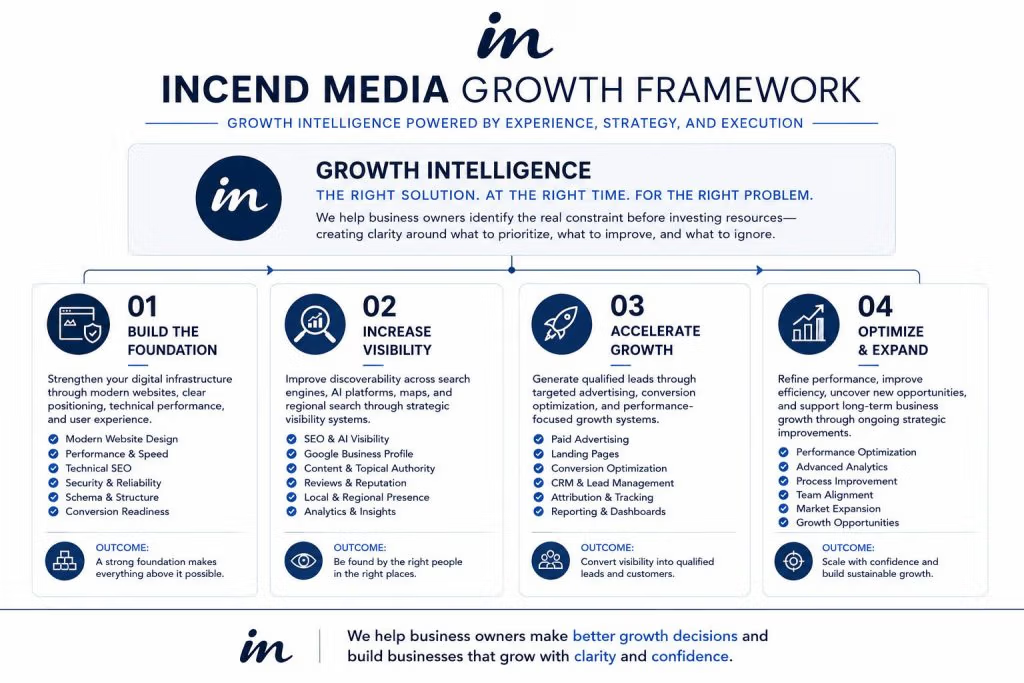
The strongest law firms understand that discoverability is no longer limited to search rankings alone. Authority is built across websites, search engines, local listings, reviews, content ecosystems, and AI-driven discovery platforms.
The following growth systems help law firms strengthen visibility, build trust, and improve client acquisition.
A law firm’s website serves as the foundation of its digital presence. It is often the first interaction a prospective client has with the firm and frequently influences whether that individual continues their evaluation process.
Modern law firm websites must do more than look professional. They must communicate trust, support search visibility, demonstrate expertise, provide a clear user experience, and guide visitors toward meaningful action. At the same time, they must satisfy the technical requirements increasingly used by search engines and AI systems to evaluate quality and authority.
Website performance, mobile usability, technical SEO, page speed, site architecture, and conversion design all contribute to long-term growth. Without a strong foundation, every other marketing investment becomes less effective.
Search remains one of the most important sources of qualified legal inquiries. When prospective clients search for legal representation, they are often actively seeking solutions and evaluating potential attorneys.
Modern SEO extends far beyond rankings and keywords. Search engines evaluate content quality, authority signals, technical performance, user experience, reputation indicators, and topical relevance when determining visibility.
Effective law firm SEO focuses on building authority around practice areas, geographic markets, and the questions prospective clients are actively asking. The goal is not simply to improve rankings. The goal is to increase visibility during the moments when legal decisions are being made.
For many law firms, local search visibility generates more opportunities than traditional organic rankings.
When prospective clients search for legal services within a specific market, Google’s local results often appear before traditional website listings. These placements receive significant attention and can heavily influence who receives phone calls and consultation requests.
Strong local visibility is driven by multiple factors, including review signals, business profile optimization, citation consistency, location relevance, website authority, and overall trustworthiness.
As competition increases, local search continues to play a critical role in law firm growth.
Search behavior is evolving rapidly.
Platforms such as ChatGPT, Gemini, Perplexity, and Google’s AI-generated search experiences are influencing how people research legal issues and discover service providers.
Unlike traditional search engines, these systems attempt to provide direct answers rather than lists of websites. To determine which organizations deserve visibility, they evaluate authority signals from across the web.
Reviews, citations, entity relationships, content quality, reputation signals, business information, structured data, and topical authority all contribute to how a law firm is understood.
Law firms that strengthen these signals today are positioning themselves for greater visibility as AI-driven discovery becomes increasingly common.
Before prospective clients hire an attorney, they often seek understanding.
They want answers to questions. They want clarity regarding legal processes. They want confidence that the attorney they select understands their situation.
Content helps bridge that gap.
When developed strategically, content strengthens search visibility, reinforces expertise, supports AI discoverability, and helps establish authority within key practice areas. More importantly, it allows law firms to demonstrate their value before the first consultation.
Strong content ecosystems become long-term assets that continue generating visibility and trust long after publication.
Trust remains one of the most influential factors in attorney selection.
Prospective clients frequently evaluate reviews before contacting a law firm. Search engines and AI systems increasingly evaluate those same signals when determining visibility.
Positive reviews reinforce credibility. Consistent review acquisition demonstrates client satisfaction. Strong reputation signals support local search performance and contribute to broader authority across the web.
As digital discovery continues to evolve, reputation has become one of the most important growth assets a law firm can possess.
Visibility alone does not generate growth.
The objective is not simply attracting attention. The objective is converting visibility into consultations, consultations into retained clients, and retained clients into measurable business outcomes.
Advertising, landing pages, intake optimization, lead tracking, CRM integration, and performance reporting all contribute to this process.
The most successful firms focus not only on generating more leads, but on improving lead quality, conversion rates, and operational efficiency. Growth becomes significantly more predictable when decisions are informed by data rather than assumptions.
The future of law firm marketing is not about chasing algorithms. It is about building authority.
Search engines are increasingly becoming answer engines. AI platforms are becoming research assistants. Prospective clients are relying on technology to help evaluate legal service providers before ever contacting an attorney.
The firms most likely to remain visible in this environment are those with strong digital foundations, authoritative content, positive reputation signals, and consistent visibility across the web.
The future belongs to firms that build authority rather than chase tactics.
Law firms do not measure success through clicks, impressions, or rankings alone.
Success is measured through consultations, retained clients, case quality, revenue growth, and long-term market position.
Our approach combines website infrastructure, search visibility, AI discoverability, reputation management, advertising, analytics, and growth strategy into a connected framework designed to support measurable business outcomes.
Rather than managing disconnected marketing activities, we help firms build systems that work together.
For many law firms, the biggest challenge is discoverability. They may have strong attorneys, satisfied clients, and meaningful experience, but prospective clients cannot choose a firm they never find. Visibility across search engines, local listings, review platforms, and AI-powered systems has become critical.
SEO helps law firms appear when prospective clients search for legal services, legal questions, or attorneys in their area. Strong law firm SEO improves visibility, builds authority, and creates more opportunities for qualified consultations.
Law firm SEO usually takes time because the legal market is competitive. Some improvements may appear within a few months, but meaningful growth often requires consistent technical optimization, content development, local SEO, reputation work, and authority building over time.
Local SEO helps law firms appear in location-based searches, including Google Maps and local search results. It focuses on Google Business Profile optimization, reviews, local relevance, citations, website authority, and geographic signals.
A Google Business Profile is often one of the first things prospective clients see when researching a law firm. It influences calls, direction requests, reviews, local visibility, and trust before someone ever visits the firm’s website.
Yes. Reviews influence both client trust and local search performance. Strong review signals can help reinforce credibility, improve engagement, and support broader visibility across search and AI-driven discovery systems.
AI search optimization helps law firms improve how they are understood and surfaced by AI-powered platforms such as ChatGPT, Gemini, Perplexity, and Google AI experiences. It focuses on authority signals, structured content, entity relationships, reviews, citations, and consistent information across the web.
AI platforms may reference, compare, or summarize law firms when users ask for guidance. While visibility is not guaranteed, firms with stronger authority signals, clear service information, reviews, and consistent digital presence are better positioned for AI-driven discovery.
Law firms should publish content that answers real client questions, explains legal processes, clarifies common concerns, and demonstrates authority within specific practice areas. The goal is not simply to blog, but to build a content ecosystem that supports trust and visibility.
Yes, but only when they are strategic. Generic blog posts rarely move the needle. Useful content should support practice-area authority, answer meaningful questions, connect to core service pages, and reinforce the firm’s expertise.
Google Ads can be useful for law firms that need immediate visibility, especially in competitive practice areas. The key is tracking lead quality, cost per consultation, signed clients, and return on investment rather than focusing only on clicks.
SEO builds long-term organic visibility, while Google Ads creates paid visibility more quickly. The strongest strategies often use both, with SEO supporting long-term authority and advertising supporting immediate client acquisition.
Traffic does not matter if visitors do not contact the firm. Conversion optimization improves the website, landing pages, forms, phone calls, and intake pathways that turn visibility into consultations.
Law firms should measure consultations, retained clients, lead quality, cost per acquisition, case value, and revenue impact. Rankings and traffic are useful indicators, but they are not the final measure of growth.
An effective law firm website builds trust, explains practice areas clearly, supports SEO, loads quickly, works well on mobile devices, highlights credibility, and makes it easy for prospective clients to contact the firm.
Social media can support visibility, trust, reputation, and brand familiarity. It may not replace SEO or advertising, but it can reinforce authority and help prospective clients feel more familiar with the firm.
Reputation management helps firms capture positive client experiences, strengthen review signals, and protect trust in the marketplace. Since many prospective clients compare reviews before contacting a firm, reputation directly influences conversion.
A law firm growth strategy connects website infrastructure, SEO, local search, reviews, AI visibility, advertising, content, analytics, and intake systems into one coordinated approach. The goal is sustainable growth, not disconnected marketing activity.
Disconnected vendors often optimize individual channels without understanding the full business outcome. A website may look good, ads may generate leads, and SEO may improve rankings, but growth suffers if those systems do not work together.
Incend Media helps law firms strengthen their digital foundation, improve search and AI visibility, build authority, improve reputation signals, generate qualified consultations, and connect marketing activity to measurable growth outcomes.
Yes. Incend Media supports law firms across multiple practice areas, including family law, personal injury, business law, estate planning, criminal defense, litigation, and other legal services.
Yes. Strong strategy can help improve lead quality by aligning content, search visibility, advertising, and conversion pathways with the types of clients and cases the firm wants to attract.
The first step is usually understanding the current foundation. That includes reviewing the website, search visibility, Google Business Profile, reviews, content, analytics, advertising performance, and intake process to identify the largest growth gaps.
Modern law firm growth requires more than marketing activity. It requires visibility, authority, trust, and client acquisition systems that work together to support long-term success.