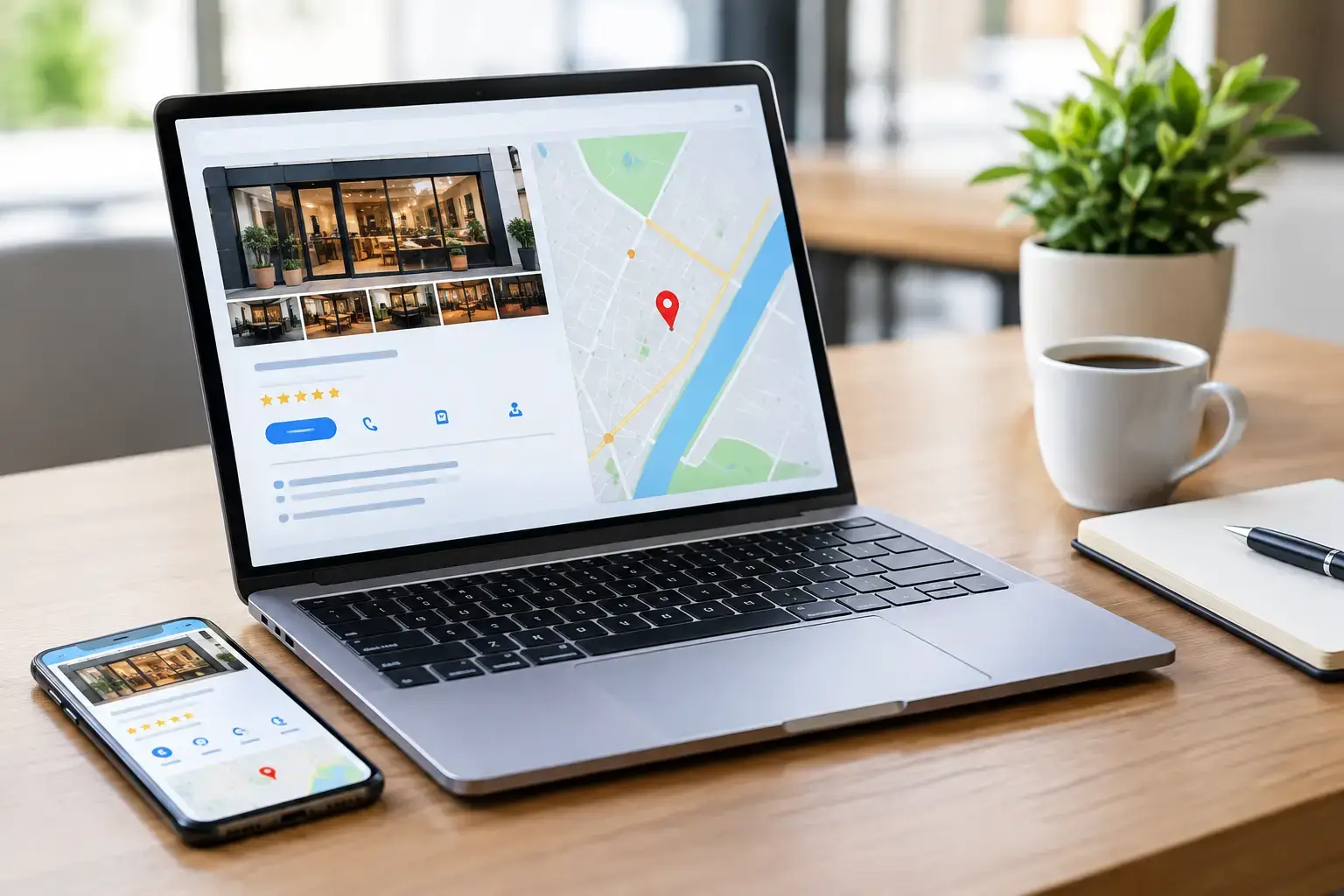
A prospective customer searching for a nearby provider is rarely looking for a marketing campaign. They are looking for a clear answer: Can this business solve my problem, serve my area, and earn my trust? Google Business Profile optimization determines whether your organization provides that answer at the moment local intent is highest.
For established businesses, this is not a task for an intern to complete once and forget. Your profile is a public operating record of your locations, services, reputation, and responsiveness. When it is incomplete, inconsistent, or disconnected from your website and lead process, visibility may be lost before a prospect ever reaches your site.
Why Google Business Profiles Affect Revenue
A Google Business Profile can appear across Maps, local search results, branded searches, and mobile discovery journeys. That makes it one of the few digital properties where a buyer can evaluate your business, contact you, request directions, read reviews, and compare service details without visiting your website.
The commercial impact is straightforward. Weak information creates friction. Conflicting hours, vague categories, unanswered reviews, and an unmonitored messaging channel cause qualified prospects to hesitate or move on. A well-managed profile reduces uncertainty and directs demand into the right conversion path.
This matters most for organizations with geographic service areas, physical locations, or regional sales teams. Healthcare groups, professional service firms, education organizations, hospitality businesses, and multi-location brands all face the same challenge: local demand is distributed, but the customer experience must still feel accurate and consistent.
The goal is not simply to appear more often. It is to create a reliable connection between local search visibility, a prospect’s decision process, and measurable lead outcomes.
Start With the Business Reality, Not the Profile Fields
The common mistake is treating optimization as a checklist of fields inside Google’s dashboard. Categories, photos, and descriptions matter, but they only work when they reflect the actual structure of the business.
Before making profile updates, establish the operating facts that should govern every location: the services offered, the markets served, the offices that receive customers, the teams that answer inquiries, and the pages on the website that support each local conversion path. If the business has multiple locations, clarify which services are truly available at each one. Copying identical details across every listing may look efficient, but it can mislead customers and weaken relevance.
This is where local visibility becomes a systems issue. Your website, location data, reviews, paid media, CRM, call tracking, and sales process should reinforce the same version of the business. A profile that drives calls to an unprepared team does not create a growth engine. It creates a reporting problem.
Choose categories with commercial intent in mind
Your primary category is a major signal of what the location does. It should describe the core business function, not a broad aspiration or a service that represents a small part of revenue. Secondary categories can provide needed context, but adding every possible option tends to dilute the profile’s focus.
The right choice depends on how customers search and how the business is organized. A specialized practice may need a more precise category than a general provider. A multi-service organization may need to prioritize the service that best reflects its principal local offering. Category decisions should be reviewed when the business model, service mix, or market positioning changes.
Build location details that remove doubt
Names, addresses, phone numbers, hours, holiday schedules, service areas, appointment options, and accessibility information all influence whether a prospect takes action. Accuracy is not a cosmetic concern. It is a trust signal and an operational requirement.
Use a local phone number when it supports customer service and attribution. Make sure stated hours match reality, especially for businesses with seasonal schedules, limited departments, or after-hours support. For service-area organizations, define coverage honestly rather than claiming a broad territory that the team cannot effectively serve.
Create a Profile That Supports the Decision Journey
A strong profile does more than describe a business. It anticipates the questions buyers ask before they call: What do you offer? Is this location relevant to me? What will the experience be like? Can I contact someone now?
Your business description should answer those questions in plain language. Explain the primary services, the audience served, and the practical reason a customer might choose your organization. Avoid stuffing city names or service phrases into every sentence. Search systems and customers both respond better to useful, specific information than repetition.
Photos deserve the same strategic treatment. Use current, credible images of locations, staff, facilities, work samples, products, and customer-facing environments where appropriate. Stock imagery may have a role on a broader brand site, but local profile images should help someone recognize the real business and feel more confident contacting it.
Posts, service details, and question-and-answer content can help keep the profile current, particularly when they address active offers, events, seasonal changes, or recurring customer concerns. They are not substitutes for foundational accuracy. A business with incorrect hours does not solve the problem by publishing more updates.
Reviews Are an Operating Signal, Not a Reputation Shortcut
Reviews influence trust, but their value extends beyond star ratings. They show prospective customers how the organization responds when service goes well, when expectations are unclear, and when issues need attention.
Build a consistent process for requesting reviews from real customers after meaningful interactions. The request should be timely, appropriate to the customer relationship, and easy for staff to execute. Do not rely on sporadic asks from individual employees. Inconsistent processes produce inconsistent feedback and make performance difficult to manage.
Responses should be professional, specific, and mindful of privacy requirements. Thank positive reviewers without sounding automated. Address critical feedback with calm accountability and an invitation to resolve the issue through an appropriate channel. For regulated industries, response policies should be reviewed carefully so teams do not disclose protected information in public.
A negative review is not always a visibility problem. Sometimes it reveals a scheduling gap, handoff failure, billing confusion, or service inconsistency that needs operational attention. Treat review themes as customer intelligence, then connect them to the leaders who can fix the underlying issue.
Connect Google Business Profile Optimization to Your Website
A profile can generate direct calls and direction requests, but the website remains essential for higher-consideration decisions. The profile and the site should work as one path, not as separate marketing assets.
Each location should point to a relevant, useful landing page when a local page is warranted. That page should confirm the location’s services, contact information, team or facility details, service area, and next step. It should also load quickly on mobile and make it easy to call, book, inquire, or find directions.
Avoid creating thin location pages that change only the city name. They may add pages to a sitemap, but they do little for a prospect who needs evidence that the location is relevant. Strong local pages contain real distinctions: the services available there, local expertise, office logistics, regional case context where appropriate, and meaningful conversion options.
For organizations with several locations, governance matters. Centralized standards protect brand consistency, while local teams need a defined process for reporting changes in hours, staffing, service availability, and customer issues. Without ownership, listings drift. With overly rigid control, local information becomes stale. The right model combines central accountability with local operational input.
Measure Outcomes Beyond Views
Views and profile interactions are useful directional metrics, but they do not tell leadership whether local search is producing qualified demand. Measurement should follow the customer journey from profile discovery to call, form submission, appointment, consultation, opportunity, and revenue where systems allow.
This requires clean attribution. Use appropriate tracking for website visits and calls, connect lead sources to the CRM, and define how teams classify local-search leads. If calls are being counted but not answered, or form fills are reaching the wrong queue, the visibility program may appear successful while revenue performance stalls.
Review data at both the location and enterprise level. A national total can hide a struggling market, while isolated local metrics can obscure broader issues in website performance, reputation management, or sales follow-up. The most useful reporting identifies where demand is growing, where conversion breaks down, and what action should happen next.
Treat the Profile as a Maintained Business Asset
Google Business Profile optimization is not a one-time cleanup. Business conditions change: offices move, services expand, teams change, customer expectations shift, and search behavior evolves. The profile needs a recurring management rhythm that checks accuracy, reviews, customer questions, engagement patterns, and conversion performance.
The organizations that benefit most do not chase every dashboard change or publish updates for the sake of activity. They maintain accurate data, strengthen trust signals, connect local visibility to a credible web experience, and hold the full lead path accountable.
The next useful question is not whether your profile is complete. It is whether a high-intent customer can move from local search to a confident conversation with your business without encountering uncertainty, inconsistency, or a broken handoff.