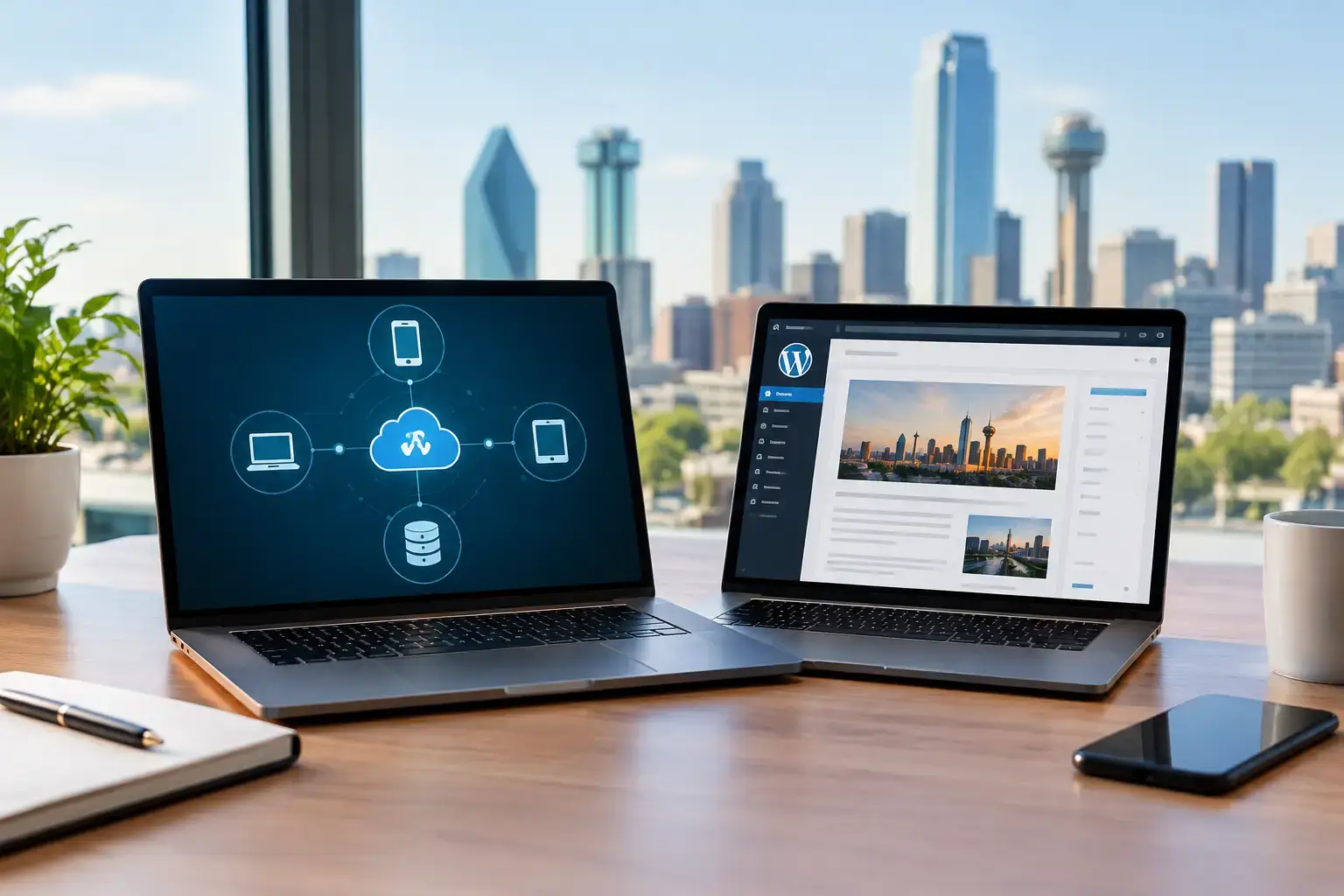
A Dallas business can have an attractive website and still lose revenue through slow publishing, disconnected lead data, weak local visibility, or a site architecture that cannot support new locations and services. Headless CMS vs. traditional WordPress: a guide for Dallas businesses is not really a debate about which technology is newer. It is a decision about how well your website supports the growth system behind it.
For many organizations, WordPress remains the right choice. For others, a headless CMS creates the flexibility needed to connect content, search performance, customer data, and multiple digital experiences. The wrong decision is not choosing one platform over the other. The wrong decision is selecting technology before defining the operational and revenue requirements it must serve.
What traditional WordPress does well
Traditional WordPress combines the content management system, website presentation layer, and publishing workflow in one environment. Marketing teams log in, create or edit a page, publish it, and see the finished result on the website. That familiar workflow is a major reason it remains widely used.
For a professional services firm, healthcare practice, regional organization, or established local business, WordPress can provide a practical foundation for content publishing, service pages, location pages, forms, and conversion-focused landing pages. It is especially effective when the website has a defined structure and the team needs straightforward editorial control without relying on developers for every change.
WordPress also has a mature ecosystem for technical SEO fundamentals, analytics connections, form handling, and content governance. Used well, it does not prevent a business from earning meaningful search visibility. The platform itself is rarely the reason a website underperforms. More often, the issue is poor implementation: unnecessary plugins, inconsistent templates, weak internal linking, bloated page assets, or no clear connection between website activity and lead outcomes.
That said, the convenience of traditional WordPress can create maintenance risk. Each plugin, theme customization, and third-party integration adds another dependency. Without disciplined technical management, speed, security, reliability, and publishing quality can deteriorate over time.
Where a headless CMS changes the model
A headless CMS separates content management from the front-end website experience. Your team still creates and manages content in a central system, but the content can be delivered to a website, mobile app, customer portal, location-specific experience, or other digital channel through APIs.
This separation matters when content must travel farther than a single website. Consider a multi-location healthcare group that needs consistent physician, service, and location data across its main site, individual location pages, appointment tools, and patient resources. Or consider a Dallas organization with several business units, each needing distinct messaging while sharing core content and brand standards. A headless model can turn that content into structured, reusable business information rather than a collection of disconnected web pages.
The front end can also be built specifically for performance and flexibility. Developers are not confined to the conventions of a traditional theme, which can help create faster, more tailored experiences when the project is engineered well.
But headless is not automatically better. It moves complexity rather than eliminating it. The business needs a development team capable of maintaining the front end, managing integrations, and protecting the publishing workflow from becoming overly technical. A headless CMS with no governance plan can leave marketers waiting on developers for routine changes, which defeats one of the central purposes of a content platform.
Headless CMS vs. traditional WordPress for Dallas businesses
The practical question is not, “Which platform is best?” It is, “What must this website do for the business over the next three to five years?”
Traditional WordPress is often the stronger choice when the primary need is an effective, manageable marketing site. If your organization publishes articles, updates service pages, runs paid-media landing pages, supports a sales team, and needs dependable local or regional visibility, a properly built WordPress site can meet those needs without creating unnecessary operational overhead.
A headless CMS becomes more compelling when your website is part of a larger digital infrastructure. That may include a complex CRM environment, multiple customer-facing platforms, extensive location data, multilingual content, personalized user journeys, or a need to distribute approved content across several properties. In those cases, the added architecture can reduce duplication and improve control over time.
Dallas businesses also face a market reality that affects this decision: many categories are crowded. Search visibility requires more than publishing a few pages and hoping they rank. Your platform must support technically sound page templates, clear topical organization, structured business information, fast experiences, conversion tracking, and content updates that reflect how customers actually search.
Neither platform guarantees those outcomes. Both can support them. The differentiator is whether the system is designed around visibility, conversion, and attribution from the beginning.
SEO is an architecture issue, not a CMS badge
There is a persistent assumption that WordPress is inherently better for SEO or that a headless build is inherently faster. Both claims are incomplete.
WordPress can be highly effective for SEO when pages are crawlable, metadata and canonicals are managed correctly, templates create consistent hierarchy, and the technical stack is maintained. It can also become slow and difficult to manage when plugin sprawl and poorly controlled customizations accumulate.
A headless implementation can produce excellent performance, but it requires deliberate SEO engineering. Search engines need reliable access to rendered content, logical URLs, internal links, sitemaps, structured data, redirects, and indexation controls. If these elements are treated as an afterthought during development, the business can launch a beautiful site with expensive visibility problems.
For organizations investing in local and regional search, location architecture deserves particular attention. A location page should not be a lightly edited duplicate of every other market page. It should reflect distinct services, local proof points, operational details, and pathways to conversion. The CMS should make this consistency easier without forcing teams to manually rebuild every page.
Publishing control should influence the decision
Executives often focus on front-end features while overlooking who will operate the system after launch. That is where CMS decisions become costly.
Ask how often your team needs to update critical content. Can marketers create a new service page without a developer? Can subject-matter experts contribute without breaking layouts? Can location managers submit updates through a controlled process? Can the organization maintain approval standards for claims, compliance language, and brand messaging?
Traditional WordPress usually offers a lower learning curve for everyday publishing. Headless systems can offer more structured content control, particularly for organizations managing large volumes of reusable data. The better option depends on the maturity of the team and the complexity of the content model.
A sophisticated platform does not create a sophisticated content operation on its own. Clear roles, templates, editorial standards, and measurement practices still matter.
Evaluate the system behind the website
Before selecting a CMS, define the surrounding infrastructure. A website that captures leads but does not pass source data into the CRM cannot clearly show which channels create qualified opportunities. A site with strong content but no conversion strategy may generate attention without supporting revenue. A fast website with fragmented service and location information may still confuse search engines and prospects.
The evaluation should include these connected questions:
- How will leads, calls, form submissions, and booked appointments be attributed?
- Which systems need to exchange content or customer data?
- How quickly must teams publish, revise, and approve information?
- Will the organization add locations, services, audiences, or digital properties?
- Who owns technical maintenance after the site launches?
These are business questions first. The CMS is the technical response.
Make the decision based on operating reality
Choose traditional WordPress when speed to market, familiar publishing, a focused marketing website, and manageable ongoing administration are the priorities. It is a strong option for many growth-oriented businesses, provided it is built with clean architecture and maintained as a core business asset rather than an occasional marketing task.
Choose headless when content must support multiple channels, systems, or experiences; when structured data and reuse are central; and when the organization has the technical capacity to manage a more composable environment. The investment can be justified when it removes real operational friction and supports expansion that a conventional site would make difficult.
For either path, the standard should be higher than a successful launch day. The right website makes it easier to publish authoritative information, earn visibility, convert qualified prospects, connect activity to revenue, and adapt as the business changes. Build for that operating reality, and the platform decision becomes far clearer.